Romantic vs. Sexual Attraction: Understanding Your Feelings
Ever find yourself drawn to someone emotionally but not physically, or vice versa? Many of us experience a fascinating difference between who we fall in love with and who we desire. It's a common source of confusion when you're figuring yourself out, but you're not alone. This journey of understanding your feelings is unique and personal.
This guide is here to help demystify the differences between romantic and sexual attraction. We'll explore various romantic orientations and show you how tools can provide valuable insights on your path to self-discovery. If you're looking for a starting point, our free and anonymous gay quiz can help you reflect on these feelings in a safe space.
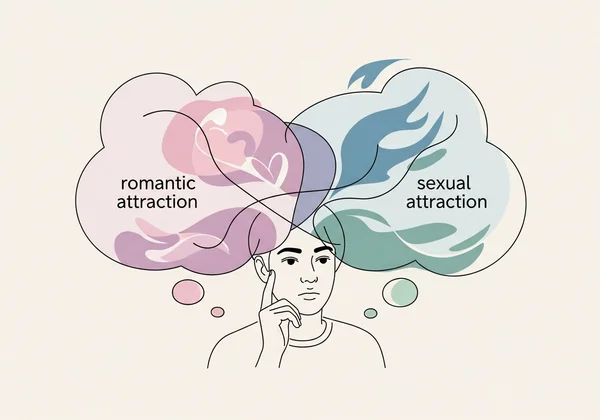
What is Romantic Attraction? Defining Your Desires
Romantic attraction is about who you want to fall in love with. It’s the feeling that makes you want to form a deep, emotional, and intimate bond with another person. This type of attraction isn't necessarily tied to physical intimacy; it's more about partnership, connection, and sharing your life with someone.
Think about the characters in your favorite stories who have a deep, non-physical bond, or the desire to simply be close to someone, share secrets, and support each other. That’s the core of romantic attraction. It's about whose hand you want to hold, not just physically, but emotionally through life's ups and downs.
The Split Attraction Model: A Key to Self-Discovery
To better understand these feelings, many people find the Split Attraction Model (SAM) helpful. Our Split Attraction Model guide explains this in depth, but the core idea is simple: this model suggests that romantic attraction and sexual attraction are two separate experiences. They can align, but they don’t have to. You might be romantically drawn to one group of people and sexually drawn to another, or feel one type of attraction but not the other.
Using this model allows for a more nuanced understanding of yourself. It creates space for identities like being homoromantic (romantically attracted to the same gender) but also asexual (feeling no sexual attraction). The SAM is a tool that validates the complex and diverse ways we connect with others, empowering you to define your own experiences.
Signs You Might Be Experiencing Romantic Attraction
How can you tell if what you're feeling is romantic attraction? While everyone's experience is different, some common signs can help you identify it. These feelings often focus on emotional connection and a shared future.
Here are a few signs you might be experiencing romantic attraction:
- You daydream about going on dates or sharing special moments with them.
- You get "butterflies" in your stomach when you think about them, but it feels more emotional than physical.
- You have a strong desire to know them on a deeper level, beyond surface-level conversations.
- You can easily picture a future with them, like traveling together or building a home.
- Their happiness is very important to you, and you want to be a source of support in their life.
Unpacking Sexual Attraction: More Than Just Physical Desire
Sexual attraction is the desire for physical and sexual intimacy with another person. It’s often what people first think of when they hear the word "attraction." This feeling is rooted in physical desire and can be an immediate, instinctual response to someone.
However, sexual attraction isn't just about looks. It can be triggered by someone's voice, their scent, their confidence, or the way they move. It’s the feeling that makes you want to be physically close to someone, to touch them, and to engage in sexual activities. It's a powerful and natural part of human experience for many people.

How Sexual Attraction Manifests Differently
Sexual attraction shows up differently for everyone. For some, it’s an instant physical reaction to seeing someone. For others, it might build slowly, triggered by a person's humor, intelligence, or the way they carry themselves. It’s not always a lightning bolt moment; sometimes it’s a slow burn that catches you by surprise.
Differentiating Between Romantic and Sexual Feelings
The easiest way to understand the difference is to think about what you desire from a person. Do you want to share your deepest thoughts and build a life together? That points toward romantic attraction. Do you feel a physical pull and desire intimate contact? That’s likely sexual attraction.
For example, you might deeply admire a friend and want them in your life forever (strong romantic or platonic feelings) but feel no desire to kiss them or be physically intimate. Conversely, you might see a stranger and feel a strong physical pull (sexual attraction) without knowing anything about them or wanting a relationship. These feelings can exist together for the same person, or they can be directed at different people.
Why Your Attractions Might Not Always Align
It's completely normal for your romantic and sexual attractions not to line up perfectly. Our feelings are complex and don't always fit into neat boxes. You might want to date men and women but only feel sexually drawn to women. Or you might feel sexual attraction but no romantic attraction at all.
There's no "right" or "wrong" way to feel. Society often presents a simplified view where romantic and sexual attraction are always linked, but reality is far more diverse. Allowing yourself the freedom to experience these feelings separately can be a huge step toward self-acceptance. Your unique combination of attractions is what makes you, you.
Exploring the Diverse Types of Romantic Orientations
Once you understand the difference between romantic and sexual attraction, you can explore the rich spectrum of romantic orientations. These labels aren't meant to confine you; they are tools to help you understand and communicate your feelings. They can provide a sense of community and validation.

Beyond Heteroromantic: Biromantic, Panromantic, Homoromantic Explained
Just as there are different sexual orientations, there are many romantic ones. The "-romantic" suffix helps specify the type of attraction.
- Heteroromantic: Romantically attracted to people of a different gender.
- Homoromantic: Romantically attracted to people of the same gender.
- Biromantic: Romantically attracted to people of two or more genders.
- Panromantic: Romantically attracted to people regardless of their gender.
- Aromantic: Experiencing little to no romantic attraction to others.
Understanding the Aromantic Spectrum: No Romantic Attraction
Being aromantic, often shortened to "aro," means a person generally does not experience romantic attraction. This is a valid orientation, not a sign that something is wrong. People on the aromantic spectrum can still feel love—like the love for family and friends—and can form deep, meaningful relationships.
The aromantic spectrum is broad. Some people may feel no romantic attraction at all, while others, like those who identify as gray-romantic or demiromantic, may feel it rarely or only after forming a strong emotional bond first.
What Are Queerplatonic Relationships (QPRs)?
Queerplatonic relationships show how connections can thrive outside romance or sex. Think of them as deep, committed partnerships built on emotional intimacy—like best friends who also share life’s big moments.
These relationships aren't romantic, but they are more intense and intimate than a standard friendship. Partners in a QPR might live together, make life decisions together, and be each other's primary support system. QPRs show that you can build a committed, loving partnership based on a foundation other than romantic or sexual attraction.
How Our Gay Quiz Can Help Clarify Your Attractions
Navigating all these feelings and terms can feel overwhelming. Sometimes, having a structured way to think about your experiences can bring clarity. This is where self-exploration tools can be incredibly helpful on your journey.
At GayQuiz.org, we want you to feel safe exploring your feelings. No judgments. No pressure. Just honest reflection. By engaging with our questions, you can start to see patterns in your own feelings and begin to understand your unique identity. The journey starts with a single step, and we're here to make it easier. You can start your test whenever you feel ready.

Reflecting on Your Feelings with Guided, Insightful Questions
Think of the GayQuiz as a conversation starter with yourself—it won’t slap a label on you, but it’ll help you spot patterns in your feelings you might’ve missed. The questions prompt you to think about different scenarios related to both emotional and physical attraction. By answering honestly, you give yourself a chance to examine feelings you might not have consciously considered before.
This guided process helps you sort through the noise and focus on your true feelings. It's a moment of private reflection, free from outside pressure or judgment. Think of it as a chat with yourself, where our quiz simply provides the questions to get you started.
The Benefits of Anonymous Self-Exploration
One of the biggest barriers to self-discovery is the fear of judgment. That's why we've made our tool completely anonymous and private. We don't ask for your name or email, and we don't store your personal data. Your journey is yours alone.
This creates a stress-free environment where you can be completely honest with yourself. When you don't have to worry about what others might think, you can explore your identity with confidence and curiosity. A safe space is essential for authentic self-discovery, and that’s what we’re committed to providing.
So, What's Next on Your Journey?
Figuring out the difference between romantic and sexual attraction is a huge step in your journey of self-discovery. Remember, your feelings are valid, no matter how they line up. It's totally okay to be confused, to question things, and to take your time.
Figuring yourself out isn't a one-time event—it's a process of learning and growing. Be patient and kind to yourself as you navigate your feelings. Your identity is a unique and awesome part of who you are.
Feeling clearer? Great. Still unsure? That’s okay too. Grab a cup of tea, hit our quiz when you’re ready, and let’s unpack this together. Ready to dive deeper? Take our free quiz now to explore your attractions further!
Frequently Asked Questions About Romantic & Sexual Attraction
Am I gay if I'm romantically attracted to the same sex but not sexually?
Labels are personal, and you get to choose what fits you best. Based on the Split Attraction Model, someone in this situation might identify as homoromantic (romantically attracted to the same gender) and heterosexual, bisexual, or asexual (describing their sexual attraction). The term "gay" is often used as an umbrella term, and it's up to you if it feels right for your experience.
Is it normal to question my sexuality and romantic orientation?
Yes, it's completely normal. Questioning is a healthy and common part of personal growth for people of all ages, especially during teenage years and young adulthood. It’s a sign that you are self-aware and thinking deeply about who you are. Many people's understanding of their orientation evolves over time.
Can a gay quiz really tell me my romantic or sexual orientation?
No quiz can definitively tell you your orientation. Your identity is your own to define. Our quiz is designed as a tool for self-reflection. It provides insightful questions to help you understand your feelings better, but it is not a diagnostic test. The purpose of our sexuality quiz is to provide a starting point for your own exploration, not a final answer.
Where can I find support if I'm confused about my attractions?
Feeling confused is okay, and you don't have to go through it alone. Consider talking to a trusted friend, family member, or school counselor. Online communities, like those on Reddit (such as r/lgbt), can offer peer support from people with similar experiences. For professional support, organizations like The Trevor Project provide resources and confidential counseling for LGBTQ+ youth.