Romantic vs Sexual Attraction: Understanding Your Identity Through Our Gay Quiz
Have you ever felt a strong connection to someone but couldn't quite put a finger on what it was? Maybe you love spending every waking moment with a person, but the idea of physical intimacy doesn't cross your mind. Or perhaps you feel a powerful physical pull toward someone you don't necessarily want to date. Many people experience deep confusion when trying to understand these feelings. You might find yourself asking, "Am I gay, or is this just a close friendship?"
Take our gay quiz to explore how romantic and sexual attraction show up in your life. This confusion is a normal part of the human experience, especially for those in their teens or early twenties. Understanding your identity is a journey, not a race. One of the most helpful ways to find clarity is to learn the difference between romantic and sexual attraction. These two feelings often go hand-in-hand, but for many people, they function quite differently. If you are feeling stuck, you can start your test to see how these patterns show up in your life.
In this guide, we will explore the fundamental differences between who we want to love and who we are physically drawn to. We know that exploring your attractions can feel overwhelming, but we're here to support you through this journey. By the end, you will have a better framework for understanding your own unique spectrum of attraction.
Types of Attraction Explained
To understand your identity, it helps to break down the different "pulls" we feel toward others. Most of us are taught that attraction is one big, messy ball of feelings. However, psychology suggests that attraction is actually made of several distinct threads. When you learn to untangle these threads, your feelings often start to make much more sense. Our gay quiz can help you identify patterns in your romantic and sexual attractions as you look through these definitions.
Defining Sexual Attraction in Your Journey
Sexual attraction is a physical pull toward another person. It is the desire for sexual contact or physical intimacy with someone specific. You might find yourself thinking about someone in a physical way. You might feel a "spark" that is rooted in your body’s response to them.
For many, sexual attraction is the primary way they define their orientation. If you feel this physical pull toward the same gender, you might identify as gay or lesbian. If you feel it toward all genders, you might be bisexual or pansexual. It is important to remember that feeling sexual attraction doesn't mean you have to act on it. It is simply an internal feeling that helps you understand your desires.
Recognizing Romantic Connections
Romantic attraction is different from physical desire. It is the desire for emotional intimacy, dating, or forming a committed "partnership" with someone. This is often described as having a "crush." You might want to hold hands, go on dates, or share your secrets. You might even find yourself wanting to build a future with this person.
While many people feel romantic and sexual attraction toward the same group of people, this isn't true for everyone. You might find that you're romantically interested in men but don't feel a strong physical pull toward them. Or vice versa. Recognizing this distinction is a huge step in answering the question of who you truly are. To help categorize these feelings, you can take our sexuality quiz for more personal insights.
Exploring Other Forms of Attraction
Attraction doesn't stop at romance and sex. There are other ways we feel drawn to people that can complicate our self-discovery:
- Aesthetic Attraction: This is simply appreciating someone’s appearance. You don't necessarily want to date them or be physical with them. It’s like looking at a beautiful painting.
- Platonic Attraction: This is the desire to be close friends with someone. Sometimes, a "friend crush" can be so strong it feels like romance, which causes confusion.
- Sensual Attraction: This is the desire for non-sexual physical touch. This includes things like hugging, cuddling, or sitting close to someone.
Understanding these categories helps you realize that "liking" someone can mean many different things.
Using the Split Attraction Model for Deeper Self-Understanding
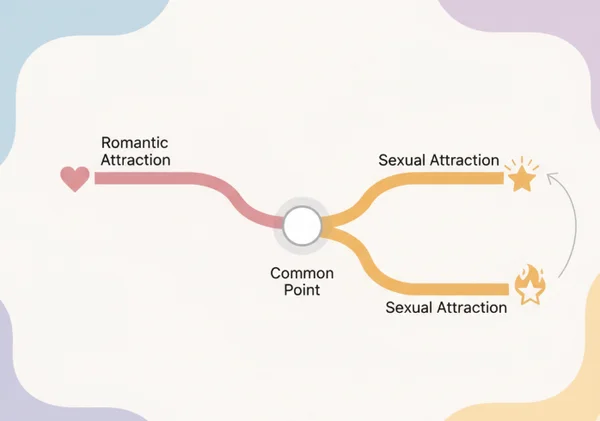
The Split Attraction Model is a concept often used in the LGBTQ+ community. It explains how our hearts and our bodies can sometimes point in different directions. This model suggests that romantic and sexual attraction are two separate "engines." Usually, they run on the same track, but sometimes they split and go different ways.
When Romantic and Sexual Attractions Don't Align
For some individuals, their romantic orientation does not match their sexual orientation. This is known as "cross-orientation" or "split attraction."
For example, a person might be biromantic. This means they feel romantic love for both men and women. However, they might be homosexual, meaning they only feel sexual desire for the same gender. When these attractions don't align, it can create a lot of internal "noise." You might feel like you are "faking it" in one area. In reality, both sets of feelings are valid.
Real-world Examples of Split Attractions
To make this clearer, let’s look at a few common scenarios:
- The Biromantic Asexual: This person falls in love and wants to date a partner of any gender. However, they don't experience sexual attraction to anyone.
- The Homoromantic Bisexual: This person is physically attracted to multiple genders. However, they only ever feel "crushes" or the desire to marry someone of the same gender.
- The Panromantic Heterosexual: This person can fall in love with anyone regardless of gender. However, their physical desires are only directed toward the opposite gender.
If any of these sound like you, you aren't "broken." You are simply experiencing a more complex form of attraction. To explore where you might land, try the free tool on our homepage.
How This Model Helps Make Sense of Confusing Feelings
Using the Split Attraction Model takes the pressure off. Instead of trying to find one single word to describe everything, you can use two words. It allows you to say, "I am romantically attracted to this group, and sexually attracted to that group."
This clarity is vital for healthy relationships. It helps you communicate your needs to potential partners. It also helps you stop judging yourself for having feelings that seem "contradictory." Once you realize that your heart and body can have different preferences, the path to self-acceptance becomes much smoother.
Take Our Sexuality Quiz to Explore Attraction Patterns
Now that you have the definitions, how do you apply them to your own life? Identity exploration is about observation. You don't have to decide your "label" today. Instead, you can start by paying attention to your patterns.
Questions to Help Identify Your Attraction Patterns
To get started, try asking yourself these questions. Be honest with yourself—there are no wrong answers:
- Who do I imagine myself growing old with? This often points to romantic attraction.
- When I see a stranger and feel a "spark," what kind of spark is it? Is it a desire to talk to them, or a physical reaction?
- Have I ever had a "crush" that didn't involve wanting to be sexual?
- In my past relationships, which parts felt the most natural? Which parts felt forced?
Reflecting on these can help you see a pattern. If you want a structured way to look at these patterns, you can start your journey by answering our guided questions.

Common Experiences of Questioning Individuals
It is very common to feel like an "imposter." You might think, "I can't be gay because I once had a crush on a girl." Or you might think, "I can't be bisexual because I'm only interested in dating men."
Many people who are questioning their identity go through phases of doubt. This is especially true if you are 16 to 24 years old. You are still figuring out who you are in the world. Remember that identity is about your internal experience, not your past history. You don't need a certain number of experiences to "prove" who you are.
How Attraction Can Evolve Over Time
One of the most important things to know is that attraction can be fluid. For some, their attractions stay the same their whole life. For others, their feelings might shift as they grow older. They might meet new people or understand themselves better.
This doesn't mean your previous identity was a lie. It just means you have new information now. Embracing the idea that you are allowed to change allows you to explore without fear. Whether your feelings stay the same or evolve, you deserve to understand them.
Understanding the Asexual Spectrum and Aromantic Orientation
Part of understanding the split between romance and sex is acknowledging those who don't experience them. This is a very important part of the LGBTQ+ community that is often misunderstood.
Demystifying Asexuality and the Asexual Spectrum
Asexuality is a sexual orientation where a person experiences little to no sexual attraction to others. It is a spectrum. Some people (gray-asexuals) might feel it occasionally. Others (demisexuals) only feel it after forming a very deep emotional bond.
Being asexual does not mean you are "cold" or that you can't love. Many asexual people have deep, fulfilling romantic relationships. They simply don't experience that specific physical "pull" that others do. If you've never felt sexually attracted to anyone, you might find our online tool helpful in seeing where you fit on this spectrum.
Aromanticism: When Romantic Attraction Isn't Present
On the other side, some people are aromantic. This means they experience little to no romantic attraction. They might have sexual desires and enjoy physical intimacy, but they don't feel the need for "dating." They often don't seek out typical romantic partnerships.
Aromantic people often value friendship very highly. They might form "Queerplatonic Relationships." These are deep, committed bonds that aren't defined by romance or sex. Just like asexuality, aromanticism is a valid and healthy way to experience the world.
Common Misconceptions and Clarifications
A common myth is that asexual or aromantic people are "waiting for the right person." Some suggest they have "medical issues," but this is not true. For most, these are innate orientations, just like being gay or straight.
Another misconception is that asexual people never have sex. Some believe aromantic people never marry. In reality, people in these communities make choices based on their personal comfort and their partners' needs. Understanding these nuances helps us be more inclusive of everyone’s unique experience.
Embracing Your Unique Attraction Pattern
Once you understand the difference between romantic and sexual attraction, it's like finally seeing the colors in a world you only saw in black and white. Understanding the difference is like turning on a light in a dark room. This doesn't change who you are, but it makes it much easier to see where you're going. Whether your attractions perfectly align or follow the Split Attraction Model, your experience is real and valid.
As you continue exploring who you are, keep these three things close to your heart:
- Labels are tools, not cages. Use them only if they help you understand yourself or find a community.
- You don't need permission. You are the only expert on your own feelings.
- Exploration is a process. It is okay to be "questioning" for as long as you need.
The gay quiz we offer is designed to help you reflect on these concepts in a safe environment. If you are ready to take the next step in your self-discovery, we invite you to start your gay quiz today. No matter what you discover, remember that making exploration easier makes life richer.
The Takeaway
Can someone experience romantic attraction without sexual attraction?
Yes, absolutely. This is a core part of the Split Attraction Model. Many people feel deep romantic love without feeling a physical sexual pull toward others. This is especially common for those on the asexual spectrum. It is also common for people to go through phases where one type of attraction is stronger than the other.
How do I know if I'm experiencing romantic or sexual feelings for someone?
A good way to tell is to imagine your "ideal" future with that person. If your daydreams involve dating and emotional closeness, that is likely romantic attraction. If your thoughts are focused on physical touch and sexual intimacy, that is sexual attraction. Often, it's a mix of both! If you're still unsure, taking an identity test can help you sort through these feelings.
Is it normal for my attraction patterns to change over time?
Yes, this is known as fluidity. Many people find that their attractions shift as they gain more life experience. This is a normal part of human development. It doesn't mean your previous feelings weren't "real."
What if I don't fit into any of these attraction categories?
That is perfectly okay. Human feelings are vast and sometimes don't fit into neat boxes. These categories are just frameworks to help us talk about our experiences. If you feel "outside" of these definitions, you are still valid.
How can I better understand my own attraction patterns?
Self-reflection is the best way to understand yourself. Keep a journal of your feelings and talk to trusted friends. You can also use resources like our free identity quiz. Giving yourself the space to be curious without judgment is the most important step.