The Kinsey Test: What Scores Mean and Where the Scale Falls Short
The Kinsey test usually refers to an online quiz inspired by the Kinsey Scale, a historical framework that describes sexuality along a continuum. The crucial distinction: the Kinsey Institute's explanation of the scale states that there is no official Kinsey Scale test. A website's score is its own interpretation, not an authoritative answer about your identity.
This guide focuses on what Kinsey ratings 0 through 6 and X mean, why different online versions can disagree, and where the historical scale falls short. If you are looking for help with this site's own results, see our separate guide to GayQuiz scores and result ranges. Those results should not be treated as official Kinsey ratings.

What Is the Kinsey Test Actually Measuring?
Alfred Kinsey and his colleagues developed the scale through research on people's sexual histories. It appeared in Sexual Behavior in the Human Male in 1948, followed by Sexual Behavior in the Human Female in 1953. The historical contribution was a continuum that challenged the idea that everyone belonged in one of two fixed categories.
The original rating summarized information gathered through interviews. Today's Kinsey scale quiz may instead ask about attraction, fantasies, relationships, or behavior and use a website-specific scoring rule. Those formats should not be treated as interchangeable.
For interpreting a result, keep three questions separate: who you feel attracted to, what experiences you have had, and how you describe your identity. Someone's relationship history need not match every attraction they experience or the label they choose.
Before interpreting any result, ask which dimension the questions emphasize. A quiz based largely on previous partners can tell a different story from one focused on present attractions, especially if your opportunities or circumstances have limited your dating experiences.
Kinsey Scale Ratings: Understanding 0 Through 6 and X
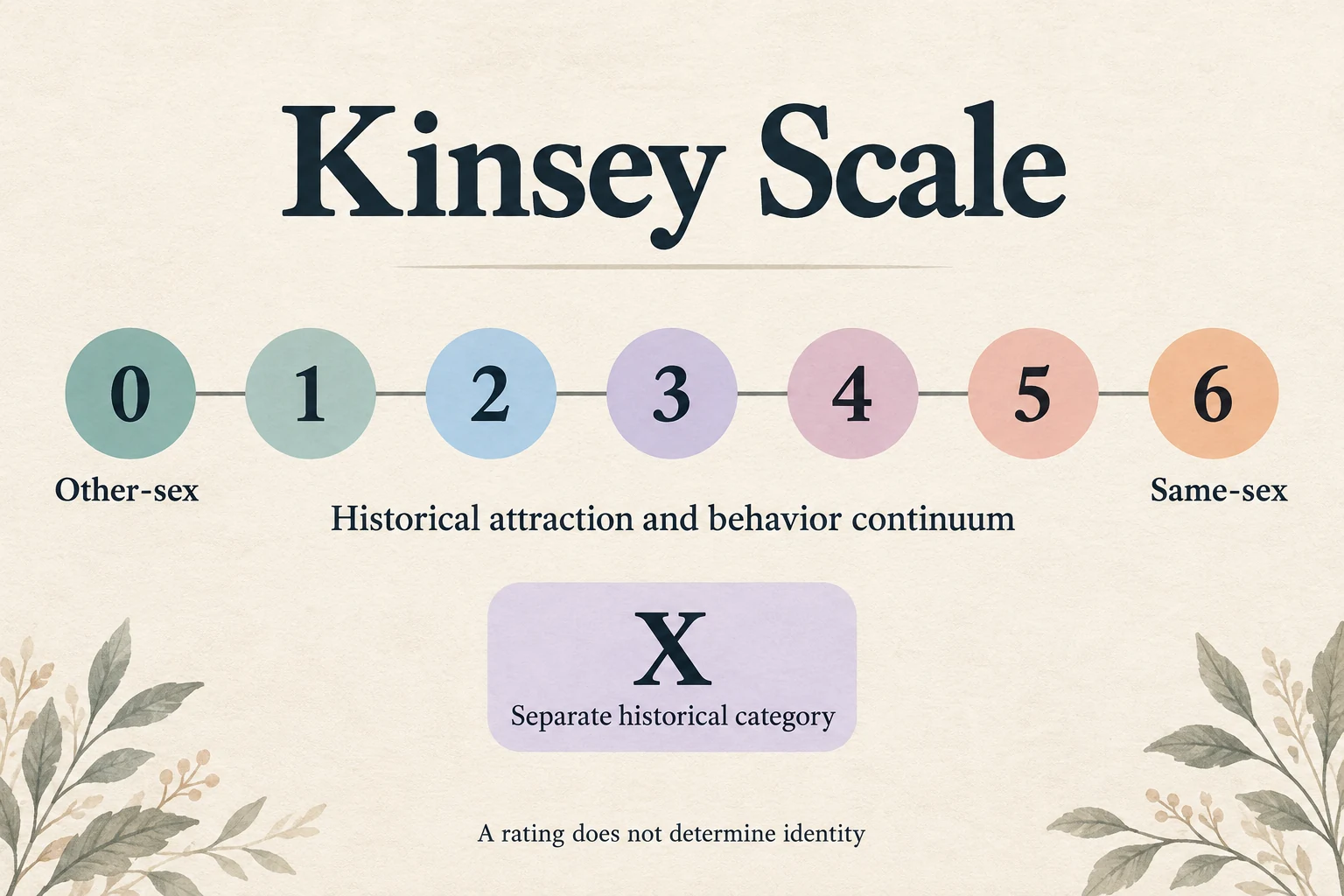
The historical scale runs from 0 to 6, with X as a separate category. The table below paraphrases the Kinsey Institute's published descriptions into accessible language; it does not create new identity categories or a method for calculating your score.
| Rating | Plain-language description of the historical scale |
|---|---|
| 0 | Exclusively other-sex attraction or behavior |
| 1 | Mainly other-sex, with incidental same-sex attraction or behavior |
| 2 | Mainly other-sex, with more than incidental same-sex attraction or behavior |
| 3 | Equal other-sex and same-sex attraction or behavior |
| 4 | Mainly same-sex, with more than incidental other-sex attraction or behavior |
| 5 | Mainly same-sex, with incidental other-sex attraction or behavior |
| 6 | Exclusively same-sex attraction or behavior |
| X | Historical category for no socio-sexual contacts or reactions |
These descriptions retain the scale's historical same-sex/other-sex framing. That framing has limits, particularly when your gender or the genders of people you find attractive do not fit a binary model.
Kinsey Scale 1 vs. 2: What Does the Difference Mean?
The distinction is between incidental and more than incidental same-sex attraction or behavior, while other-sex attraction or behavior remains predominant. The wording does not provide a universal percentage threshold.
For a hypothetical example, one person may describe an isolated same-sex attraction; another may describe a recurring pattern alongside stronger other-sex attractions. That can help illustrate the language, but it is not a rule for assigning either person a number.
If you are wondering whether you are a 1 or 2 on the Kinsey Scale, consider what the description leaves out. Does the quiz distinguish an attraction from admiration? Does it ask about a particular period of your life? Those questions may explain more than the difference between two scores.
Does Kinsey Scale 3 Mean You Must Be Bisexual?
A 3 is the midpoint in the historical framework. It does not require a particular identity label. Bisexuality does not require equal attraction to different genders, so a midpoint should never become a test of whether someone is "bisexual enough."
Likewise, results of 4 or 5 are not instructions to stop identifying as bisexual, gay, queer, or another term that fits your experience. The rating describes a limited pattern within a model. For a broader discussion of attractions and labels, read our guide to recognizing bisexual feelings beyond a score.
Is X the Same as Asexuality?
X is a historical category, not a modern asexuality assessment. Lack of sexual behavior alone does not establish an absence of sexual attraction. The numbered scale also does not describe romantic attraction separately, leaving important experiences outside its structure.
Why a Kinsey Scale Test Online or PDF Can Give Different Results
An online quiz or downloadable worksheet may look like a standardized Kinsey questionnaire. The Kinsey Institute explicitly distinguishes internet quizzes from its interview-based research; the historical ratings were not assigned through a self-scored quiz.
Independent creators may choose different questions, response options, timeframes, and scoring formulas. Two quizzes can therefore return different numbers without either revealing a hidden, definitive identity. A longer questionnaire or a polished PDF does not, by itself, establish stronger evidence.
Before comparing results, check three things: what the questions measure, which period of your life they cover, and how answers become a rating. A quiz about lifetime partners and one about current fantasies are summarizing different information, even if both display the same 0-to-6 scale.
For a hypothetical example, someone who has only dated other-sex partners may still report recurring same-sex attraction. A questionnaire focused on partner history could describe a different pattern from one focused on attraction. This illustrates the effect of question design; it does not establish which result is that person's "true" Kinsey number.
Can You Convert a Quiz Percentage Into a Kinsey Number?
A percentage is not automatically a Kinsey rating. Multiplying a quiz result by six, or treating 50 percent as a Kinsey 3, assumes that the questionnaire and historical scale measure the same thing in the same way. Without a defined and justified mapping, that conversion has no established meaning.
The percentage bands in GayQuiz's own results guide are that site's explanations of its quiz. They are not a conversion table for the historical scale. When a website borrows Kinsey's language, distinguish the framework it references from the scoring system it actually uses.
A Kinsey 3 also does not mean that exactly half of someone's partners must have been the same sex, or that every attraction divides neatly into two equal percentages. The historical midpoint is a descriptive category, not a calculation of how much of an identity someone has.
Why Is the Kinsey Scale Considered Outdated?
Its simplicity remains recognizable, but the same simplicity limits what it can describe. A single line cannot fully represent gender, different kinds of attraction, lived circumstances, and identity language.
It Compresses Distinct Experiences Into One Number
Sexual attraction, romantic interest, behavior, and self-identification may differ. For example, a person might notice attraction to multiple genders while having dated only one. Treating relationship history as the complete picture would miss that distinction.
Its Gender Framework Can Be a Poor Fit
The original wording relies on heterosexual and homosexual categories organized around same-sex and other-sex experiences. That can be difficult to apply meaningfully for nonbinary people or for attraction that is not organized around a two-category gender model.
A Midpoint Cannot Describe Attraction Intensity
Consider two hypothetical people: one experiences strong attractions to multiple genders; another rarely experiences sexual attraction at all. "Equal" attraction alone cannot convey the difference between them. Direction and intensity are different questions.
A Result Needs Context Over Time
A quiz result reflects the answers you gave under that quiz's rules. Different wording, a different timeframe, or a different understanding of a question can change the outcome. Changes in a number should not automatically be treated as proof that your orientation changed.
The scale is therefore best approached as a historical reference and a possible conversation starter. Its shortcomings become especially important when a website presents the result as a complete explanation of a person.
What Replaced the Kinsey Scale?
There is no single universally adopted replacement. Researchers and educators use different approaches depending on what they want to describe.
| Approach | What it adds | Important boundary |
|---|---|---|
| Klein Sexual Orientation Grid | Multiple dimensions considered across past, present, and ideal circumstances | More detail still does not determine your identity |
| Storms model | Separate axes for same-sex and other-sex erotic attraction | Broader geometry does not capture every aspect of sexuality |
| Separate attraction, behavior, and identity questions | Keeps distinct dimensions visible rather than merging them into one score | Answers depend on question wording and context |
The Kinsey Institute's overview of other sexual orientation scales describes the Klein Grid as having seven variables considered across past, present, and ideal circumstances. Considering several dimensions and timeframes can make differences visible that a single rating leaves out.
The Storms model places two dimensions on separate axes rather than assuming that increasing one necessarily reduces the other. Neither model removes every limitation of historical gender language.
A more detailed model can address a specific limitation of the Kinsey Scale without becoming a universal identity test. Choose a framework according to the question it helps explain, rather than treating additional detail as proof of greater certainty.

How to Read a Kinsey Result Without Overinterpreting It
Read the number alongside the questionnaire's source, focus, and timeframe. A useful interpretation would be: "Under this quiz's rules, my answers about current attraction were placed in category 2." That statement preserves the context that "I am a 2" leaves out.
If the creator does not explain the scoring, the number alone cannot show how the rating was assigned. If the questions do not fit your experience, another decimal place or another attempt will not resolve that mismatch.
For the broader question of why a result may feel too narrow, see why a quiz result can feel incomplete. The key boundary for a Kinsey-inspired quiz is simple: it can offer a description under its own rules, but it cannot require an identity label or stand in for the full picture of your sexuality.
FAQ
What Is the Kinsey Test?
The phrase usually refers to a third-party quiz inspired by the historical Kinsey Scale. The Kinsey Institute states that an official Kinsey Scale test does not exist. Online versions should be evaluated according to their own questions and scoring methods.
What Does Kinsey Scale 2 Mean?
It indicates mainly other-sex attraction or behavior with more than incidental same-sex attraction or behavior within the historical framework. It is not a fixed percentage or a required identity label. A quiz's explanation also depends on how that quiz assigns ratings.
Does Kinsey Scale 3 Mean Exactly 50 Percent Gay?
No. The midpoint describes an equal balance within the scale's categories, not a measured percentage of identity. It also says little about how strong or frequent someone's attractions are, or which label they prefer.
Why Is the Kinsey Scale Outdated?
It compresses several experiences into a single continuum and uses historical binary terminology. It has limited room for nonbinary experiences, romantic attraction, and attraction intensity. Its historical importance does not make it a complete modern description of sexuality.
What Replaced the Kinsey Scale?
No one framework replaced it everywhere. Alternatives include the Klein Sexual Orientation Grid, the Storms model, and separate questions about attraction, behavior, and identity. Each approach answers different questions and has its own limitations.
Is There an Official Kinsey Scale Test PDF or Full Test?
There is no official standardized self-administered Kinsey questionnaire. A downloadable worksheet can explain the ratings or offer reflection prompts, but its PDF format and question count do not make it an official instrument.
What Does a Kinsey Scale Distribution Chart Tell Me?
It shows how ratings were distributed in a particular sample using particular methods. Before applying it broadly, check who participated, when the data were collected, and how ratings were assigned. A population chart cannot tell you which identity label fits you.